The aerospace industry is undergoing a profound transformation. The growth of air traffic, the expansion of space programmes and the transition towards more efficient aircraft are redefining the design and manufacturing priorities of the entire supply chain.
The pursuit of lightweight design and greater efficiency is reshaping the sector: new aircraft, higher-performance engines and increasingly ambitious space programmes. Reducing weight means reducing fuel consumption. Improving efficiency means extending range, lowering emissions and increasing competitiveness.
In this context, precision engineering plays a central role. Every structural component, every engine part and every critical element must contribute to a delicate balance between lightweight design and strength, performance and long-term reliability.
A global supply chain with increasingly demanding standards
OEMs, Tier 1 suppliers and specialised manufacturers now operate within a highly integrated global network, where delivery times, traceability and regulatory compliance are fundamental elements of the process. Cost pressures coexist with increasingly demanding quality standards, while next-generation programmes require higher production volumes and greater manufacturing flexibility.
In this environment, the machine tool is no longer an isolated element of the shop floor but a strategic node within the supply chain. Reliability, repeatability and dimensional stability must be ensured not only for a single batch, but throughout extended and fully certified production cycles. Every geometric deviation, thermal instability and unexpected machine stoppage impacts the entire value chain.
Competitiveness in the aerospace industry no longer depends solely on component design, but on the ability to manufacture components consistently, with total accuracy and continuous process control.
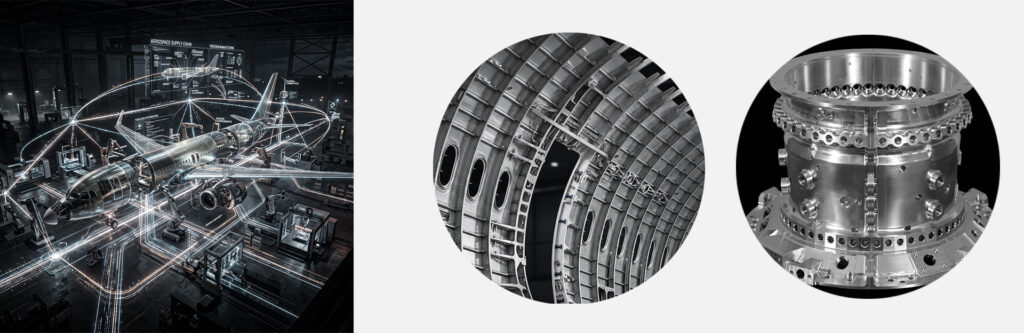
Advanced materials: lightweight without compromise
The drive for efficiency has accelerated the adoption of increasingly high-performance materials. High-strength titanium alloys, nickel-based superalloys for hot engine sections and advanced structural composites have become the standard in next-generation aerospace programmes.
These materials reduce weight and improve performance, but they also introduce highly demanding manufacturing requirements.
Titanium requires dynamic control and effective vibration management. Superalloys demand structural rigidity and thermal stability under load. Composites require smooth machine movements and consistent accuracy to prevent delamination and surface defects.
The machine tool therefore becomes an integral part of the engineering strategy. It is no longer simply a matter of adapting cutting parameters, but of relying on an architecture capable of systematically controlling forces, heat and vibration.
Structural components
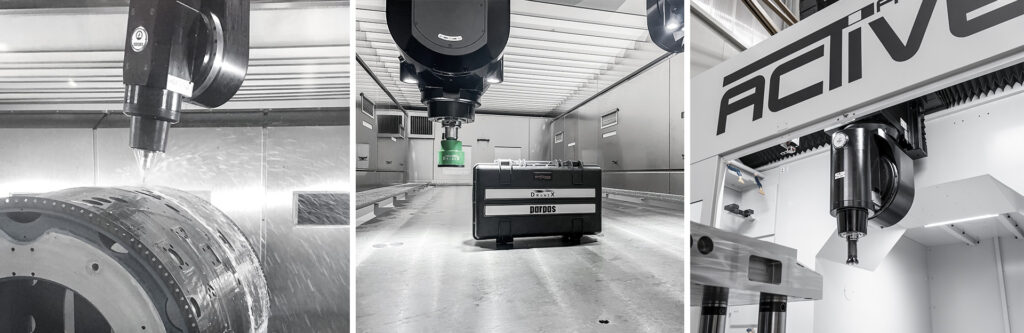
Aircraft structures represent one of the most complex manufacturing challenges. Spars, frames, structural panels and fuselage components require machining over extended lengths, often incorporating complex geometries and internal lightweighting features designed to reduce mass without compromising strength.
Machining these components requires a delicate balance between rigidity and dynamics. On one hand, component dimensions demand machine structures capable of maintaining geometric stability over long travel distances. On the other, the pursuit of lightweight design results in thin sections and structurally sensitive areas that cannot tolerate vibration or micro-deformation during machining.
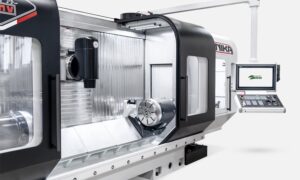
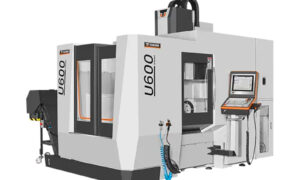
In this context, high-rigidity gantry platforms such as XS represent a technological benchmark. The structural architecture, designed to ensure stability under load, combined with thermal control of the machine structure and optimised kinematics, further enhanced by torque motors on the rotary axes, enables consistent geometric accuracy throughout the entire working envelope, even during extended production cycles. For lightweight alloys and composites, where dynamic performance becomes even more critical, full linear motor platforms such as SPEEDLINER and DIAMOND deliver maximum productivity in 5-axis machining.
Mass management, guideway precision and controlled dynamics make it possible to machine large structural components while minimising vibration and dimensional drift. It is not merely a question of achieving tolerance, but of maintaining it consistently and repeatability in line with the requirements of a certified aerospace supply chain.
Aircraft engine components
If aircraft structures represent a dimensional challenge, engine components stand at the highest level of geometrical and functional complexity.
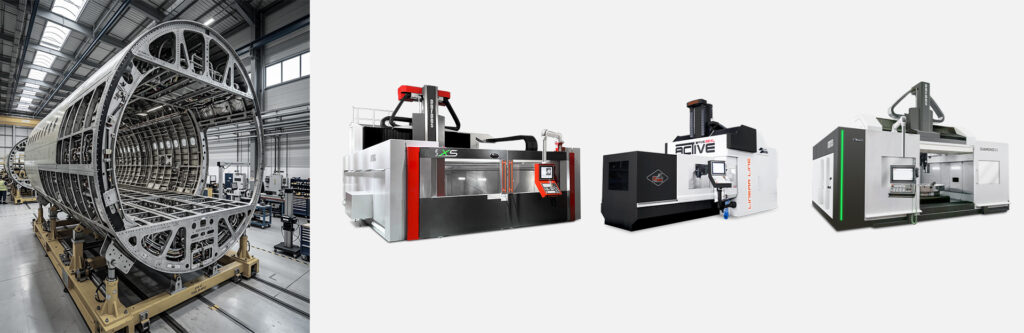
Blades, blisks and turbine discs operate under extreme conditions: high temperatures, elevated rotational speeds and continuous cyclic loads. Every surface must conform to highly precise aerodynamic profiles, with micrometre-level tolerances and tightly controlled surface finishes.
UNIKA BLADE was developed specifically to meet these requirements. Its moving-column structure, full linear motor configuration and integration of in-house electro-spindles and rotary tables enable high-speed machining while maintaining dynamic control and stability under load.
Simultaneous 5-axis toolpaths require smooth acceleration, zero mechanical backlash and predictable behaviour, even when machining difficult materials such as titanium and superalloys. In this context, the machine is no longer simply a production tool, but a technological platform capable of transforming a digital model into a perfectly compliant component.
Creating efficiency through precision
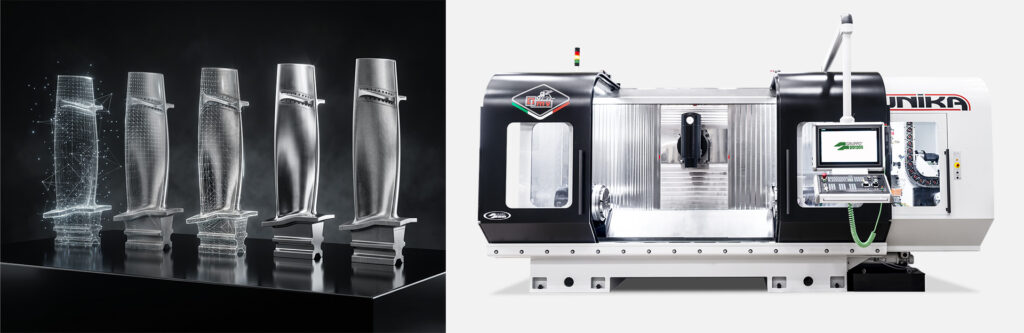
In the aerospace industry, lightweight design and efficiency are not merely engineering objectives; they are industrial requirements that influence the entire supply chain.
Reducing weight means rethinking materials and geometries. Increasing performance means working to ever tighter tolerances. Maintaining competitiveness means manufacturing with continuity, stability and complete process control. It is within this balance between engineering and production that the true value of technology emerges.
For Gruppo Parpas, supporting the evolution of the aerospace sector means designing machine platforms capable of sustaining this complexity over time, transforming sophisticated geometries and advanced materials into perfectly repeatable components. It is not simply about building machine tools, but about creating the industrial conditions that make the future of flight possible.
For further information on Gruppo Parpas, please contact Leader CNC Technologies.
Written by: Riccardo Broggio, Gruppo Parpas